To win every stage of the AI funnel, test the questions buyers ask AI assistants at each stage, on general assistants like ChatGPT and on retailer assistants like Amazon’s Alexa for Shopping, and track how often your brand is left out. That gap is purchase exclusion: when an AI assistant answers a buyer’s question without naming your brand, you lose the sale before the buyer ever visits a website.
I'm Kara Lineal, a marketing executive for consumer products, B2C, D2C, and B2B brands that want AI built into marketing operations. I have more than 20 years of experience building consumer brands and D2C e-commerce, including a D2C channel built to $5M at 65% margin, and I now apply agentic AI to the work.
Buyers used to search Google, visit a few websites, and decide which brands to consider. Now, many ask AI to make that list for them.
The shift is happening across consumer shopping and business buying:
Consumer shopping: Capgemini's 2025 consumer research, based on a survey of 12,000 consumers in 12 countries, found that 58% use generative AI instead of traditional search engines as their go-to source for product and service recommendations. Up from 25% in 2023.
Business buying: G2's March 2026 survey of 1,076 B2B decision-makers found that 51% of software buyers start their research with an AI chatbot more often than with Google, up from 29% eleven months earlier.
Retail shopping: Amazon reports that more than 350 million customers used its AI assistant, Alexa for Shopping, in the previous 12 months.
For marketers, this creates a new challenge. If an AI assistant recommends three products and leaves yours out, buyers may never consider your brand.
That is purchase exclusion: being left off the buyer’s list before you have a chance to compete. Marketing teams need to track whether AI recommends their brand, and it is just as important to measure as traffic, conversion, or share of voice.
Buyers are changing how they research, but search still matters
Not everyone has switched to AI. Bain's September 2025 survey of 1,500 consumers found that 56% mostly or always start with search engines, compared with 16% who mostly or always use chatbots. Among millennials and Gen Z, 42% mainly use search engines.
The takeaway is not to abandon search. It is to plan for buyers using Google, AI assistants, and retailer shopping assistants to find and compare products, often in the same purchase. Your brand needs to be visible across these channels, as each one answers questions differently and each one needs a plan.
The good news for brands that show up: AI-referred shoppers are increasingly valuable. Adobe reported that in March 2026, visitors from AI sources to U.S. retail sites converted 42% better than other traffic. A year earlier, they were 38% less likely to buy.
What purchase exclusion means
Purchase exclusion is when an AI assistant answers a buyer's question without including your brand, so the buyer may never know your brand was an option.
Traditional marketing metrics can miss this. There is no impression, click or website visit to track, just a missed chance to be considered.
In my AI visibility audit of a bathroom fixtures brand, the brand appeared in nearly every general AI assistant response (ChatGPT, Gemini). But when I asked retailer shopping assistants the same questions, the brand was largely excluded (Home Depot, Lowe’s). The brand was visible during general research but missing where shoppers could buy.
This strategy is designed to find and close those gaps. The five steps below work for consumer and B2B brands, whether they sell directly, through retailers, or both.
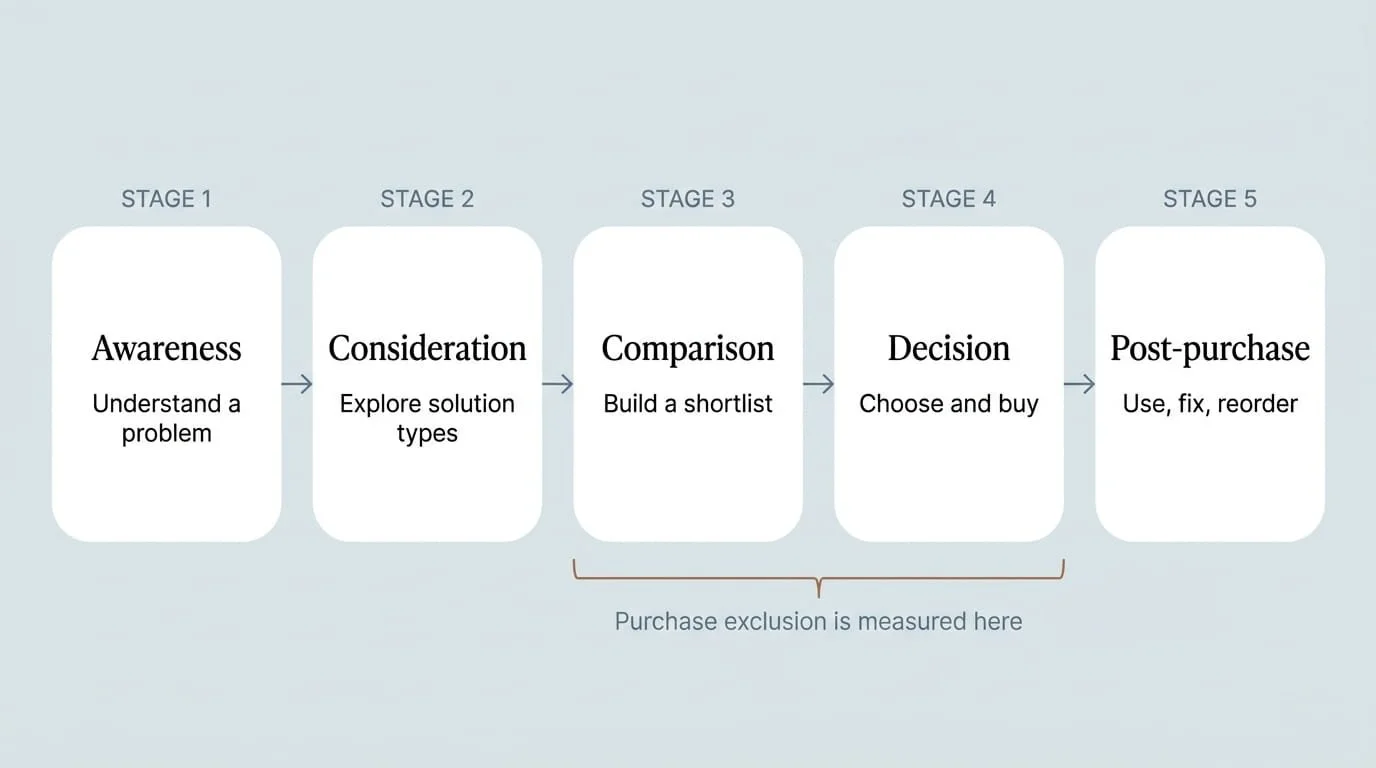
Step 1: Build a list of buyer questions for each funnel stage
Buyers don't type keywords into AI assistants. They ask full questions, often with context about their situation. Your testing needs to reflect that.
Start with 5 to 10 questions for each stage of the buying process in each product category. Use language from:
Sales calls
Customer service conversations
Customer reviews
Searches on your website
These natural language inquiries (NLIs) will help you test whether AI assistants include your brand as buyers explore options, compare products, and decide what to buy.
| Funnel stage | Buyer intent | Example B2C inquiry | Example B2B inquiry |
|---|---|---|---|
| Awareness | Understand a problem | "Why does my bathroom faucet keep dripping after I replace the washer?" | "What causes listeria contamination in food processing drains?" |
| Consideration | Explore solution types | "What type of faucet lasts the longest in a home with hard water?" | "What drain cleaning methods are approved for food manufacturing plants?" |
| Comparison | Build a shortlist | "What are the best bathroom faucet brands under $200?" | "Which suppliers sell sanitary drain brushes for dairy plants?" |
| Decision | Choose and buy | "Is [Brand] or [Competitor] better for a guest bathroom?" | "Does [Supplier] offer next-day shipping on sanitation supplies?" |
| Post-purchase | Use, fix, reorder | "How do I install a [Brand] faucet cartridge?" | "What replacement parts fit [Product model]?" |
Two ways to make your test questions more useful:
Include buyer context. Add details real buyers mention, such as budget, household size, industry, compliance requirements, or the problem the buyer needs to solve. AI answers change based on context.
Write branded and unbranded versions. Questions without your brand name test whether AI includes you. Questions with your brand name test how AI describes you.
Keep your questions in a shared spreadsheet
Use the same set of questions each testing cycle so you can compare results over time. For each question, record:
| Field | What to include |
|---|---|
| Category | The product line or service |
| Funnel stage and intent | Where the buyer is in the process and what they need |
| Branded or unbranded | Whether the question includes your brand name |
| Buyer context | The persona or buyer’s situation |
| Source | Where the question came from, such as a sales call, support ticket, or review |
| Business priority | Revenue or margin weight, so results can be scored by business impact |
Review the questions each quarter so that they reflect new products, seasonal needs, and competitor launches that change what the buyer is asking.
Step 2: Test across the AI platforms your buyers use
Build your test list around two groups: general AI assistants and retailer shopping assistants.
General AI assistants
AI assistants help buyers research topics, compare options, and get recommendations using training data, web search, and their own ranking logic. Major platforms include:
ChatGPT: OpenAI reported more than 900 million weekly active users in March 2026.
Google Gemini app: Alphabet reported 950 million monthly active users in July 2026.
Google AI Mode and AI Overviews: Google said in May 2026 that AI Mode passed 1 billion monthly users and AI Overviews 2.5 billion.
Others to include: Perplexity, Microsoft Copilot, Claude, and Meta AI, depending on your audience.
These usage figures show scale, not a direct ranking: some measure weekly users, while others measure monthly users.
Retailer AI shopping assistants
Do not overlook AI assistants inside retail websites and apps. They help people choose products while they are already shopping. They live inside retail sites and apps, one click from the cart, and they pull from the retailer's own catalog, reviews, and merchandising logic.
Examples include:
Amazon’s Alexa for Shopping, formerly Rufus: Amazon reported more than 350 million customers used it in the previous 12 months. Interactions increased more than fivefold year over year.
Walmart’s Sparky: Walmart reported that shoppers who use Sparky spend 40% more per order than those who do not, as reported by Yahoo Finance.
The Home Depot’s Magic Apron: The Home Depot says it answers millions of questions each month and is expanding to its 2,000+ U.S. stores.
Lowe’s Mylow: According to PYMNTS’ reporting on Lowe’s August 2026 results, online shoppers who use Mylow are three times as likely to make a purchase.
If you sell through retailers, make these assistants a priority in your testing. The key question is whether they recommend your products when shoppers are ready to buy.
How to run the tests
Repeat each question at least three to five times on each platform. AI answers vary from run to run.
Use a logged-out or new session where possible so your previous activity doesn’t skew results.
Save the full response. Record the platform, question, date, brands mentioned, order of appearance, sources cited, and exact wording.
Use AI to help review the results. Identify brand mentions, placement, and positive or negative sentiment. Have a person spot-check the findings.
Step 3: Build a strategy for each platform
Do not treat AI as one channel. Use your test results to identify where your brand appears, where it is missing, and how each platform describes it.
Then build a platform-specific plan to address those gaps. Each platform rewards different signals. A single "AI strategy" won't cover them all.
| Platform type | What it relies on | What to improve |
|---|---|---|
| Google AI Overviews and AI Mode | Google's index, structured data, Merchant Center, Business Profile | SEO foundations, Product structured data, accurate Merchant Center feeds, clear answers on key pages |
| ChatGPT, Perplexity, Copilot, Claude | Web search results, third-party sources, reviews, training data | Earned media, expert content, reviews, consistent brand facts across the web, allowing search crawlers access |
| Gemini app | Google's index and knowledge sources | Same foundations as Google, plus strong brand and entity information |
| Retailer assistants | Retailer catalog data, reviews, ratings, Q&A, price, availability | Complete product listings, attributes, images, review volume and rating, answered questions, competitive price and stock |
For retailer AI assistants, start by reviewing the products they recommend instead of yours. Compare those listings with yours:
Ratings and number of reviews
Product details and images (content completeness)
Price
Availability
Look for gaps you can address.
Step 4: Match your content to each customer intent
The funnel stage tells you where buyers are in the process. Their intent tells you what they need to hear. Plan content for five needs:
| Buyer intent | What they need | What to provide |
|---|---|---|
| Learn (awareness) | Clear explanations | Expert-written how-to guides, FAQs, and explanations of common problems |
| Explore (consideration) | Help choosing options | Buying guides that explain important features, best use cases, and tradeoffs |
| Compare (shortlist) | Evidence to narrow the list | Third-party reviews, ratings, awards, and industry coverage |
| Buy (decision) | Confidence to purchase | Accurate, consistent pricing, availability, shipping, returns, and warranty details across your site and retailer listings |
| Use (post-purchase) | Help after purchase | Installation guides, compatible parts, and troubleshooting information |
Step 5: Measure purchase exclusion
Track whether AI includes your brand, not just whether it sends visitors to your website.
Add these measures to your marketing dashboard:
Coverage rate: The percentage of inquiry runs where your brand appears at all.
Exclusion rate: The percentage of unbranded comparison and decision inquiries where your brand does not appear. This is the purchase exclusion metric.
#1 recommendation rate: How often you are the first or top recommendation.
Sentiment: Whether mentions are positive, neutral, or include caveats.
Stability: How much results change across repeated runs.
AI referral traffic and conversion: Visits and sales from AI sources in your analytics.
Break results out by platform, funnel stage, and product category. Averages hide the problem. A brand can be highly visible for one product line and excluded for another.
Common pitfalls
Testing only questions that name your brand. Asking "Is [Brand] good?" tests how AI describes you, not whether it would recommend you, and will almost always return your brand. Include questions that do not name your brand, as the exclusion problem only shows up in unbranded comparison and decision questions.
Testing only ChatGPT. Include the platforms your customers use to research and shop, whether that is Google AI Mode, a retailer assistant, or an industry-specific tool.
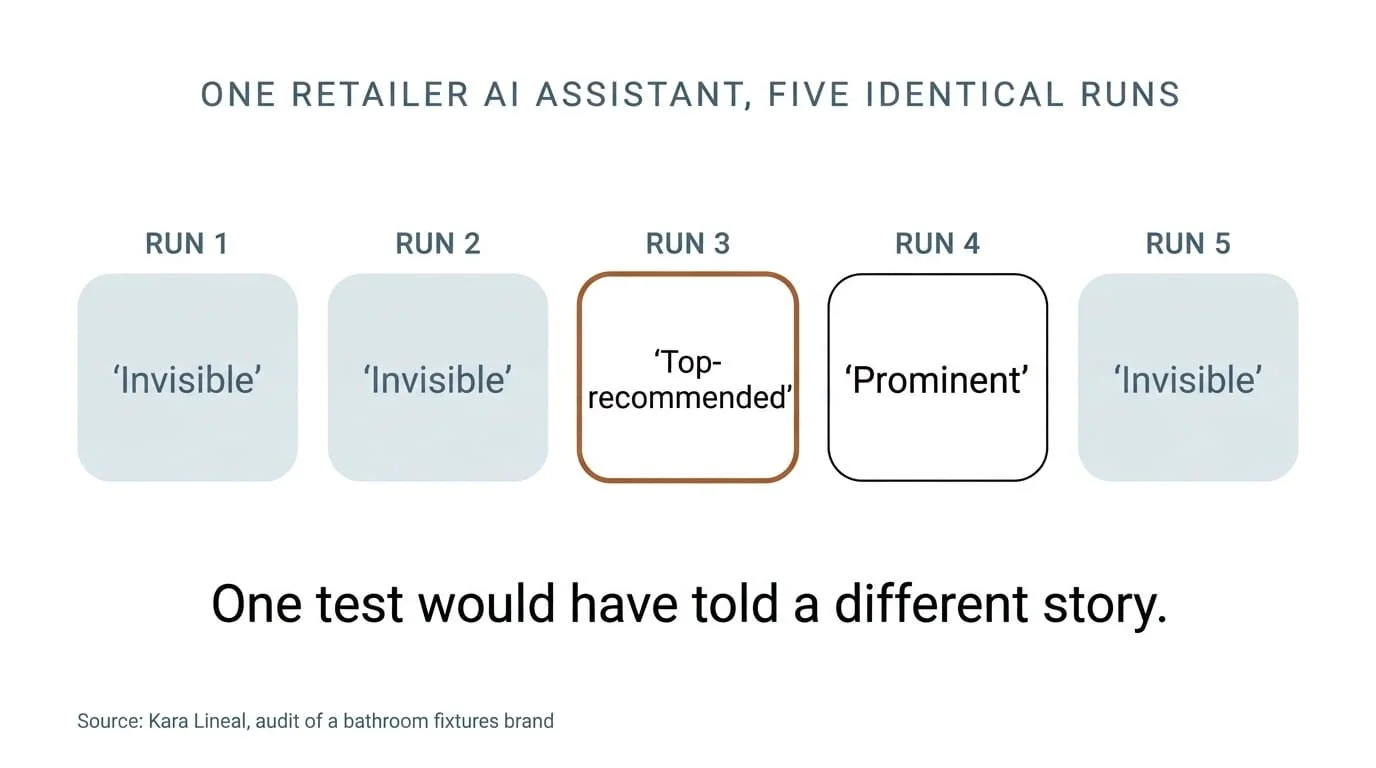
Trusting a single test as the answer. In my audit, five identical tests on one retailer assistant produced very different results: the brand was missing three times, the top recommendation once, and prominently mentioned once. One test would have given an incomplete picture.
Averaging across the catalog. Strong results for one product line can hide poor results for another. Report each category separately.
Improving content without fixing product data. Retailer assistants rely heavily on catalog data, reviews, ratings, price, and availability. A great blog post does not fix an incomplete retailer listing.
Keeping findings inside marketing. Share the results with the teams that can make changes, including e-commerce, merchandising, customer service, and retail account teams. Share exclusion data with the people who can act on it.
Who owns what
| Team | Role in AI funnel strategy |
|---|---|
| Marketing | Builds the inquiry set, runs testing, owns reporting, creates expert and educational content |
| E-commerce | Improves product pages, structured data, feeds, and site readability |
| Retail account and merchandising teams | Improves retailer listings, reviews, ratings, and content syndication |
| Sales and customer service | Supplies real buyer questions and flags where AI answers are wrong |
| PR and communications | Builds third-party coverage that general AI assistants draw on |
A simple 90-day plan
Days 1 to 30: Measure where you stand
Choose two or three high-margin product categories.
Write 25–50 questions buyers would ask (natural language inquiries), covering every funnel stage from research to purchase and use.
Test those questions on four to six AI platforms, including at least one retailer shopping assistant.
Save the results as your baseline starting point.
Days 31 to 60: Fix the biggest gaps
Find where AI excludes your brand.
Start with improvements you can make quickly: complete retailer listings, clearer product-page answers, structured product data, and more customer reviews.
Days 61 to 90: Test again and track progress
Repeat the tests and compare results with your starting point.
Measure how often your brand appears, is excluded, or ranks as the #1 top recommendation.
Set a monthly or quarterly testing schedule.
What this means for marketing leaders
The funnel still exists. Buyers still research, compare, and choose. What is changing is who helps them decide which brands to consider.
When AI builds that list, your brand can be left out before a buyer ever reaches your website. Website traffic and conversion reports alone will not show that missed opportunity.
Test real buyer questions at every stage of the funnel across general AI assistants and retailer shopping assistants. You will get a clearer picture of where your brand appears and is recommended, where it is missing, and what needs attention.
The goal is not just to win the clicks (that increasingly don’t happen). It is to make the buyer’s list.
For your top category, which AI assistants exclude your brand? Reply in comments below.
Frequently asked questions (FAQs)
What is purchase exclusion in AI marketing?
Purchase exclusion is when an AI assistant answers a buyer's question without including your brand, removing you from consideration before the buyer visits a website. It can be measured as the percentage of unbranded comparison and decision inquiries where your brand does not appear.
How many consumers use AI for product research?
Capgemini's 2025 research found 58% of consumers have replaced traditional search engines with generative AI tools as their go-to for product and service recommendations, up from 25% in 2023. IBM and NRF reported in January 2026 that 45% of consumers turn to AI for help during their buying journeys.
Should brands optimize for retailer AI shopping assistants?
Yes, especially brands that sell through retailers. Assistants like Amazon's Alexa for Shopping, Walmart's Sparky, The Home Depot's Magic Apron, and Lowe's Mylow answer questions one click from purchase and rely on product listing content, reviews, ratings, price, and availability.
Sources
Capgemini, "What Matters to Today's Consumer" (January 2025)
G2, research on B2B software buyers and AI chatbots (April 2026)
Bain & Company, "Why Consumers Choose an AI Chatbot Over a Search Engine" (2025)
Adobe, AI traffic to U.S. retail sites (April 2026)
OpenAI, ChatGPT weekly active users (March 2026)
Alphabet, Q2 2026 CEO remarks (July 2026)
Yahoo Finance, coverage of Walmart's Sparky earnings commentary (August 2026)
The Home Depot, Magic Apron expansion release (August 2026)
PYMNTS, coverage of Lowe's Mylow earnings commentary (August 2026)
IBM Institute for Business Value and NRF, consumer study (January 2026)
Kara Lineal, "AI Visibility Audit: What It Tells You About Your Brand"
AI-assisted research and drafting; independently reported, verified, and edited by the author.