AI grant research system replaced a nonprofit’s manual process.
Kara Lineal built an AI system for the Hannah Center board that researches and scores grant funders against the nonprofit's mission, replacing a manual process that depended on volunteers with spare time.
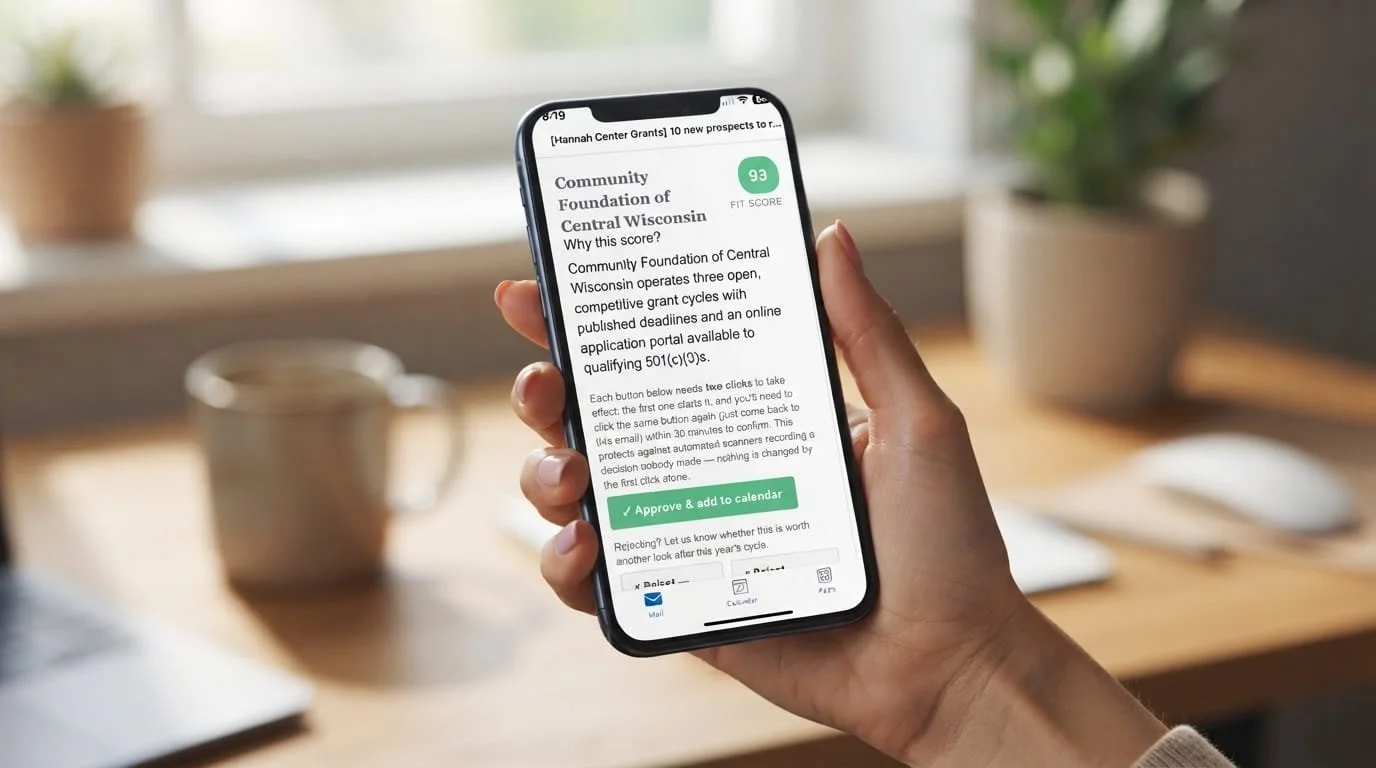
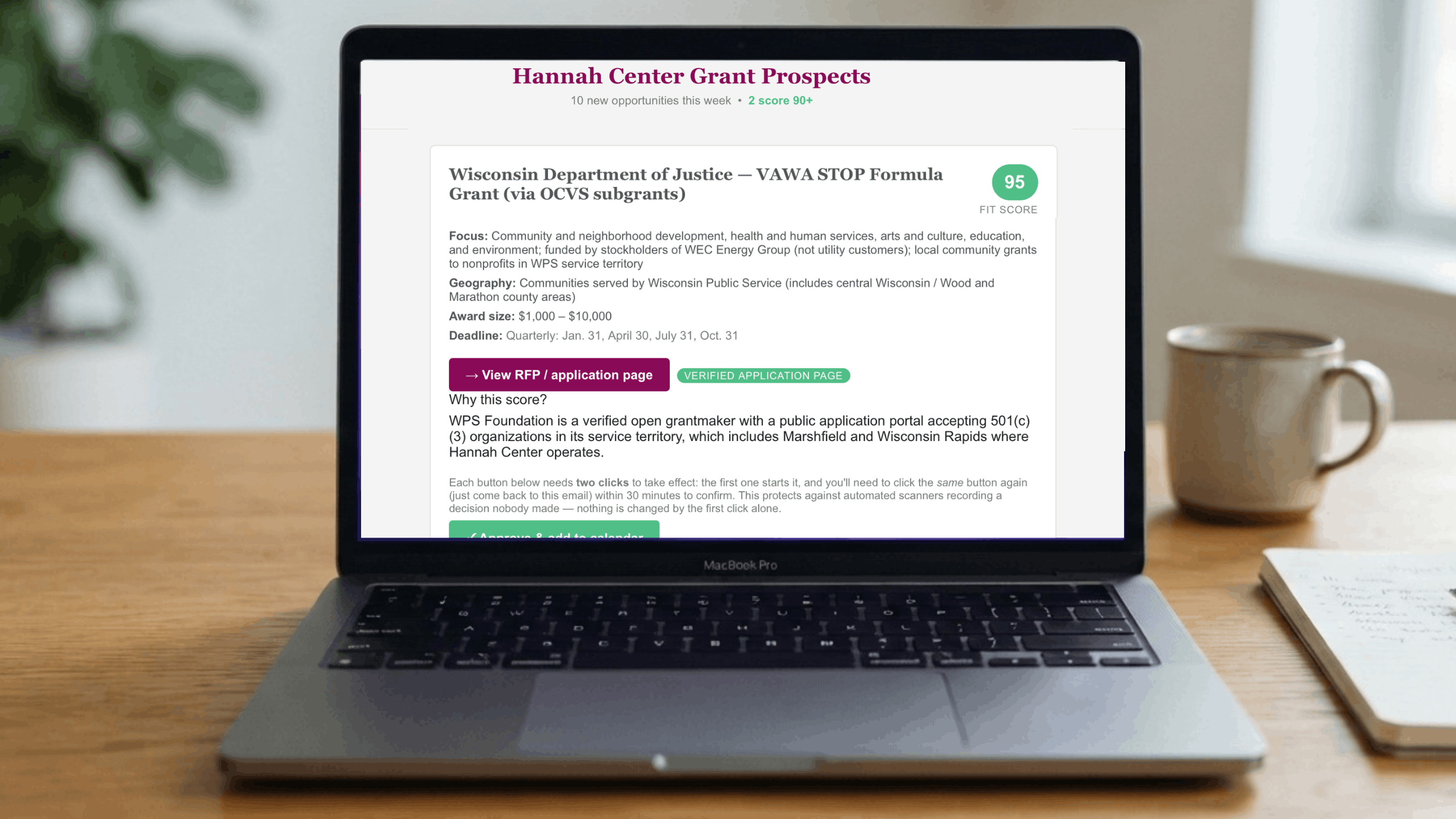
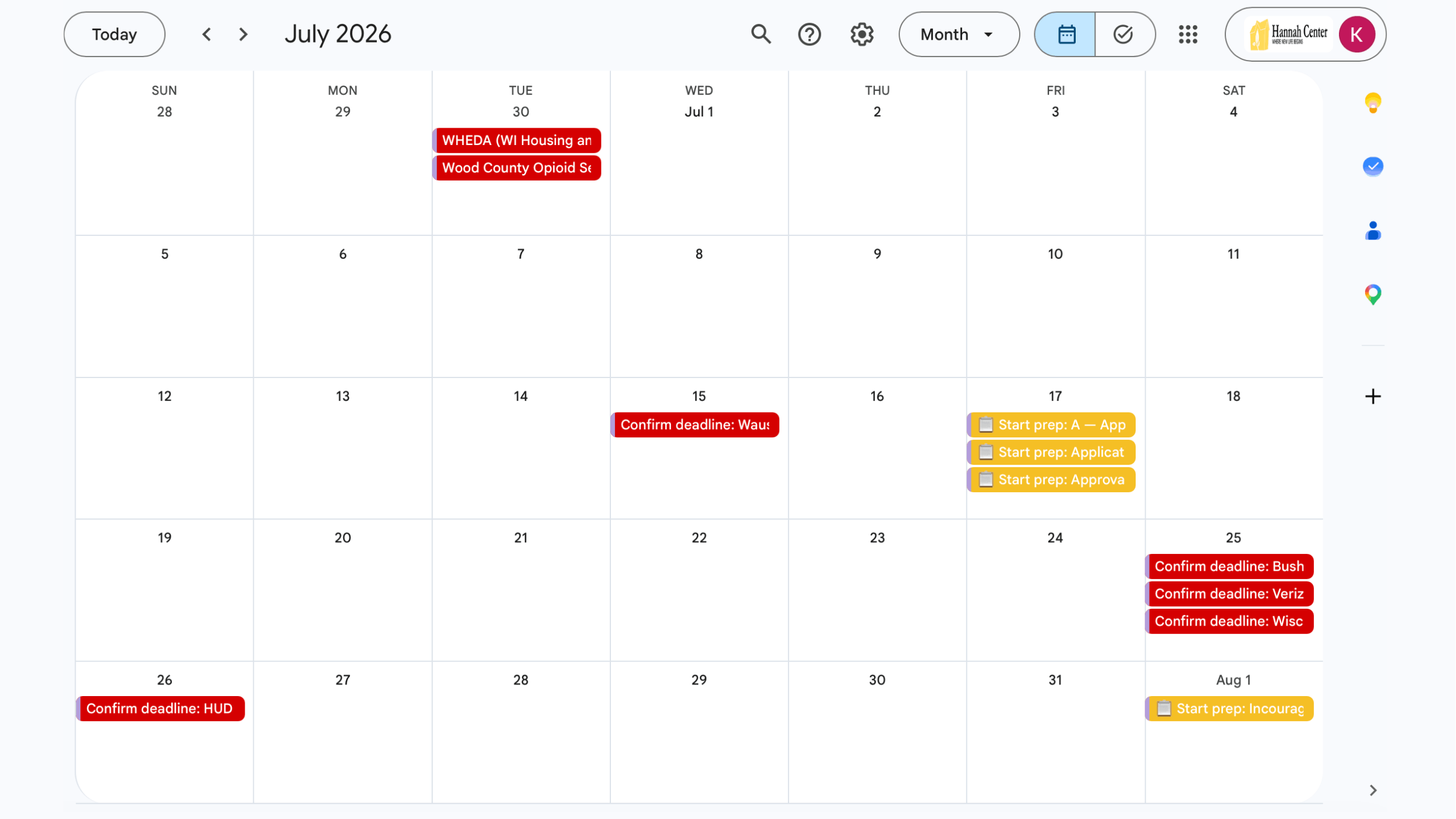
The AI-assisted workflow runs for under $15 a year. It finds and evaluates grant opportunities, then emails volunteers a short summary with buttons to approve or reject each one. Approved grants go straight into a shared grant committee calendar. The AI system replaces about 30 minutes of manual research per prospect for roughly $1 a month.
Hannah Center Inc. (nonprofit women's shelter) | Board of Directors, Marketing and Public Relations | 2025 to present.
-
funders researched and scored by AI
-
all-in cost to run the system
-
manual hours saved per month
Challenge
Hannah Center’s board found grant opportunities by hand. A volunteer searched for funders, checked eligibility, assessed how well each grant fit the shelter’s mission, and tracked deadlines in scattered notes. The process was slow and depended on volunteers who had spare time to work on it.
As a volunteer board member leading marketing and public relations, Kara Lineal built a production system to manage that work from start to finish.
“The challenge wasn’t a lack of grant opportunities. It was finding the volunteer time to identify the right grants and keep them moving on a deadline.”
What she did
Kara Lineal directed the design and build of an AI system that does the funder research continuously, using AI development tools. What it does:
Sources leads.
A monthly discovery run searches the web for new funders. Across five runs it pulled 48 raw leads and deduplicated them to 21 net-new watchlist candidates.Researches and scores funders.
The system scores each candidate against the nonprofit’s mission criteria. It has researched 58 candidate funders across its active months, 71 scoring evaluations in all.Triages without human time.
16 candidates were auto-rejected at the eligibility and fit gate, so no volunteer spent time on them.Keeps a human in the loop.
42 candidates were surfaced to a volunteer committee for review through a no-login, one-click email approval that records the decision. 32 decisions are on record, 14 through the one-click flow and 18 through the earlier process.Closes the loop in a shared calendar.
Every approved prospect becomes a funder record and a dated deadline event. 10 of 10 approvals created both. 15 renewal windows and 3 special deadlines sync hourly to a shared Google Calendar, each with a 60-day prep reminder.
She also commissioned a security and reliability review, and designed the rejection logic to be reversible. The system revisits rejected funders after a year, unless a person marks a funder as permanently ineligible.
“AI does the research and organizes the options. Volunteers make the decision. For roughly $1 a month, we give volunteers back the time they used to spend researching every prospect.”
The results
The system researches grant prospects for about $1 a month. Total AI costs are under $15 a year, using free-tier infrastructure. Researching 58 prospects by hand would take about 29 hours a year. The system filtered out 16 before they reached a volunteer, saving about eight hours. For prospects that need a committee decision, a process that once took 30 minutes of research now takes about a minute and two clicks.
A reliability review found that failed link checks had caused 13 legitimate funders to be rejected as having no open program. All 13 were recovered and scored again. The quality review also added 105 automated tests, pinned dependencies, and safeguards against race conditions, injection paths, and approvals triggered by scanners. Every human decision has an audit trail.
As an AI-assisted production system built for a nonprofit volunteer board, this example demonstrates what it takes to put AI to work in marketing responsibly: a human must be accountable for its cost, its decisions, and what happens when it breaks.
“My job was to make sure the system was useful, affordable, and dependable. We could identify what happened when something went wrong.”
Why it worked
Kara Lineal treated the system as an operating asset: she tracked its cost, built volunteer feedback and decisions into the workflow, and put safeguards in place before relying on it. The same principles apply to any marketing team: someone must be accountable for what an AI system costs, what it decides, and what happens when it breaks.
Safeguards include 105 automated tests, pinned dependencies, a security review, and an audit trail for every human decision. AI researches and sorts the prospects; people decide what to pursue.
Accelerate your marketing engine.
Hire a fractional CMO who has built the channels, the teams, the AI-assisted automation, and owned the results.
