
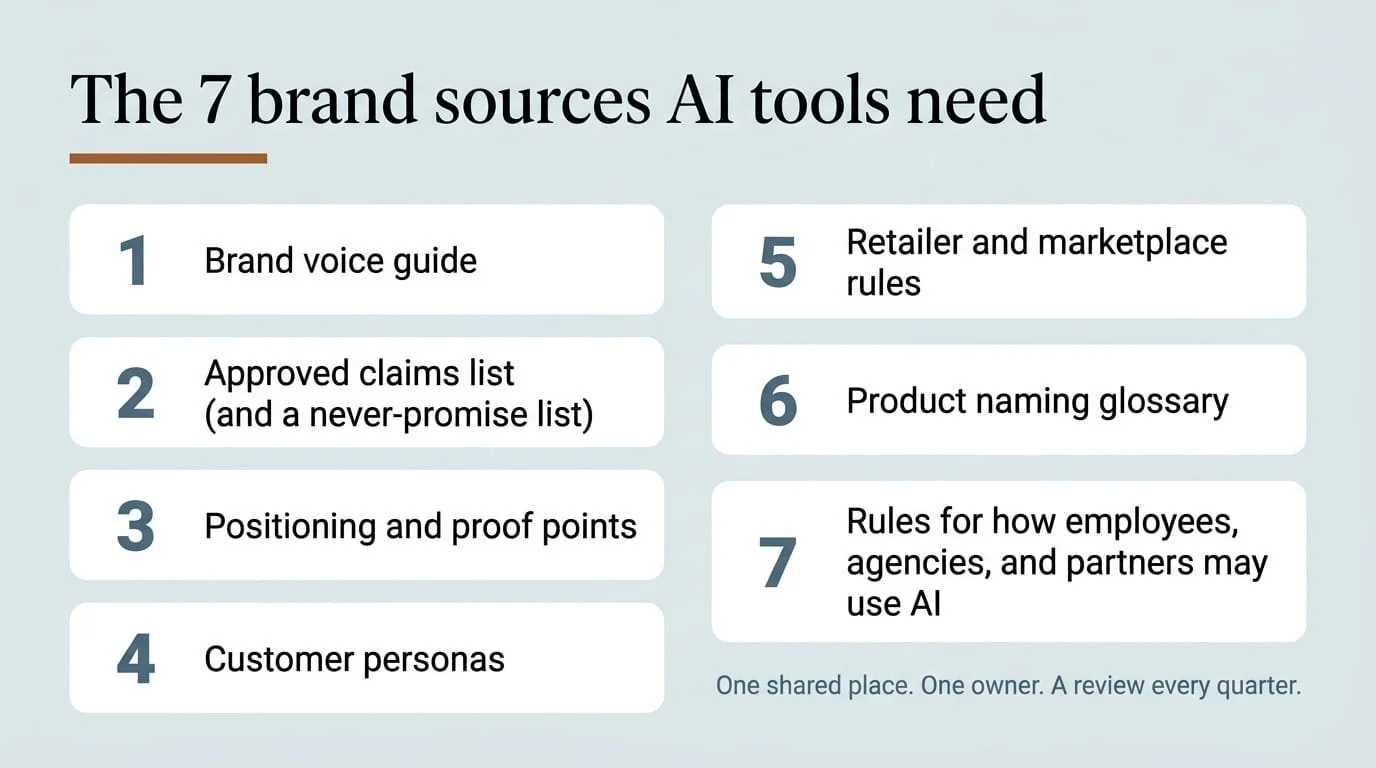
Give AI tools one approved, current set of brand sources: a brand voice guide, an approved claims list with a never-promise list, positioning and proof points, customer personas, retailer and marketplace rules, a product naming glossary, and written rules for how employees, agencies, and partners may use AI. Keep all seven in one place with one owner, so every person and every tool works from the same version.
I'm Kara Lineal, a marketing executive for consumer products, B2C, D2C, and B2B brands that want AI built into marketing operations. I have more than 20 years of experience building consumer brands and D2C e-commerce, including a D2C channel built to $5M at 65% margin, and I now apply agentic AI to the work.
Brand truth is the approved, current set of voice, claims, positioning, personas, and retailer rules that people and AI tools use to describe your brand.
Why this matters now
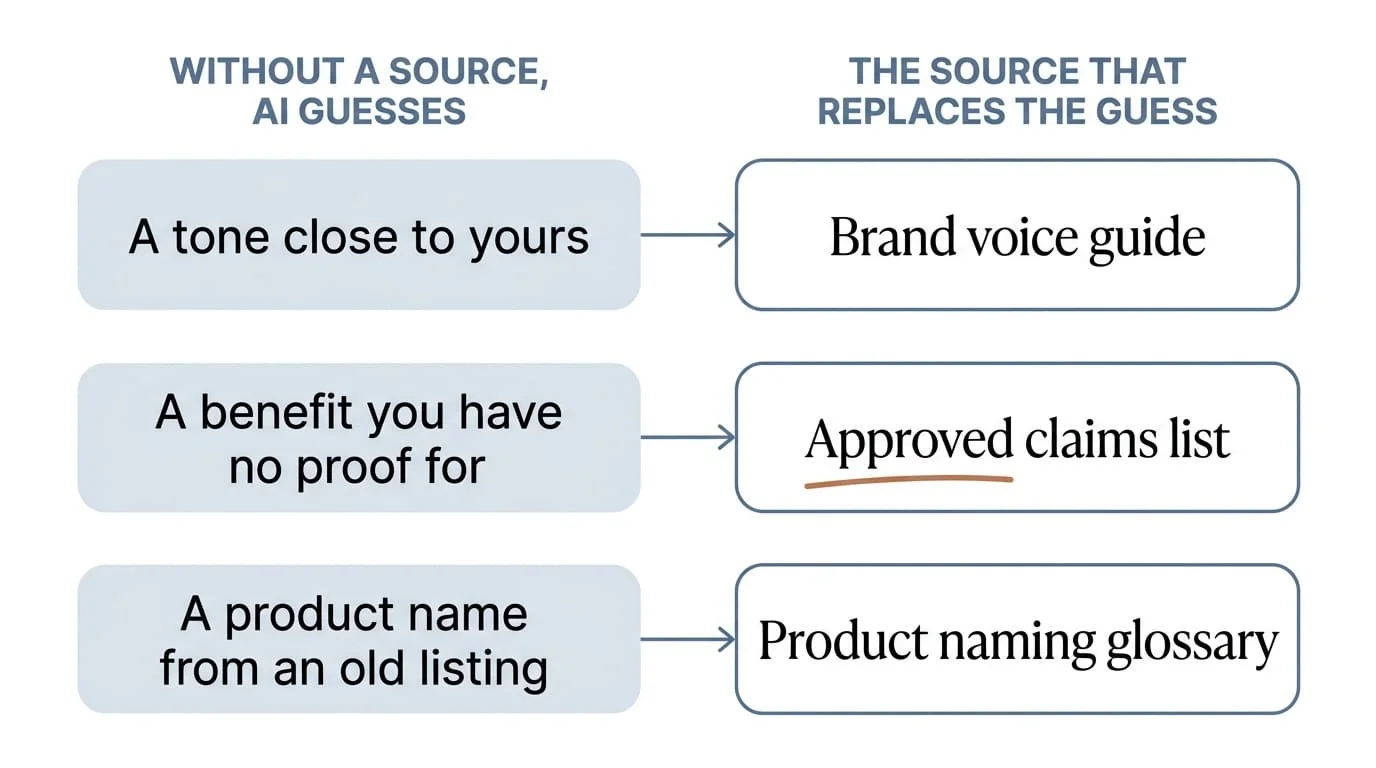
An AI tool writes from whatever you give it. When it has no approved source for your voice, your claims, or a retailer's rules, it fills the gap by guessing. The guesses read well, which is why they get past a quick review: a tone close to yours, a benefit you have no proof for, a product name from an old listing. You get off-brand copy and claims nobody signed off on, on your product pages, in retailer listings, and in ads.
Consumer brands that sell through national retailers have more at stake. Each retailer has its own content rules, and a listing that breaks them can be rejected or pulled.
When an agency works from an old voice guide and no claims list, I’ve seen the copy drift further from the brand with every round of edits. Claims no one approved end up in product copy, and listings get held because the content breaks a retailer’s rules. The fix is one current, approved source the agency and its AI tools work from.
Each of the seven sources below replaces one kind of guess with an approved answer.
What should a brand voice guide for AI include?
A brand voice guide tells people and AI tools how your brand sounds, and shows it in real examples they can follow.
What it is: A short document, often one page, that describes your brand's voice and gives examples a writer or AI tool can follow.
What goes in it: Eight parts:
Audience: who you're talking to.
Voice traits: each trait, with what it means.
Words to use.
Words to avoid.
Before-and-after examples: at least five, rewritten from real copy.
Channel notes: how the voice changes across channels.
Style rules: capitalization, punctuation, numbers, prices, dates, and form of address.
Owner and review date.
What goes wrong without it: AI tools default to a generic, upbeat voice that could belong to any brand in your category. A guide with traits but no examples gives writers adjectives ("warm," "confident") and no picture of what those words look like in your copy.
One sign yours is out of date: Nobody has updated it in the last year, or its examples come from products you no longer sell.
Many voice guides describe the brand voice with adjectives like “warm” and “confident” and stop there. Without before-and-after examples of real copy, every writer and every AI tool reads those words differently.
What should a claims list include?
An approved claims list is the one place your brand records every product and brand claim it may make, in the exact words it may use.
What it is: A table with one row per claim. Never paraphrase a claim on the list; the wording in the row is the wording that gets used.
What goes in it: For each claim:
Exact wording.
Proof.
Who signed it off.
Sign-off or review date.
Where it may be used: channels and retailers.
Required disclaimers, or a note that none is needed.
Which products it applies to.
The never-promise list: Keep a short companion list of what the brand must never say or promise, such as outcomes you can't prove or guarantees your warranty doesn't cover. Give it to every agency and every AI tool alongside the claims list.
Counsel review: Claims about health, safety, the environment, or children's products need counsel's review before they go on the list.
What goes wrong without it: AI tools borrow claims from competitors, old packaging, and reviews, then state them as fact. A claim that was true for one product shows up on another. When someone asks who approved it, nobody did.
One sign yours is out of date: A claim on the list still applies to a product you've reformulated or discontinued, or its review date has passed.
Inaccurate product claims can be costly mistakes. When we launched the refreshed Therapedic brand at Bed Bath & Beyond, the packaging said “antibacterial” without naming which part of the product was antibacterial, and the EPA advised that the claim had to say exactly that. We sent crews into more than 500 stores to sticker over every package by hand.
How do you write brand positioning AI tools can use?
Positioning and proof points tell AI tools who your brand is for, what it does better than the alternatives, and the evidence behind each statement.
What it is: One page that leadership has agreed on, with the proof attached to every point.
What goes in it: Five parts:
Who the brand is for.
The problem it solves for them.
What it does better than your main competitors.
Proof for each point: test results, ratings, sales data, or awards.
The date you last checked it against competitors' claims, prices, reviews, and shelf presence.
What goes wrong without it: Ask an AI tool for "why choose us" copy without your positioning and you get category benefits every competitor can also claim. The copy is accurate and gives a shopper no reason to pick you.
One sign yours is out of date: It hasn't been checked against competitors in the last year, or it isn't in your agency and AI briefs.
What customer personas do AI tools need?
Customer personas describe who buys from you, why they buy, and what they ask before buying, in your customers' own words.
What it is: Two or three short profiles built from your own data rather than assumptions.
What goes in it: Six parts:
Who buys: the customer, in a sentence or two.
Why they buy: the job the product does for them.
What almost stopped them: the doubt you need to answer.
Their words: how they describe the product to a friend.
Top questions and approved answers: the answer you want given on shipping, returns, warranty, and fit.
Sources: reviews, support logs, sales data, and recent interviews or surveys.
What goes wrong without it: AI tools write for an average shopper. The copy answers questions your customers don't ask and misses the one that stops them at the shelf.
One sign yours is out of date: Nobody has interviewed or surveyed customers in the last two years.
Why do AI tools need retailer and marketplace rules?
Retailer and marketplace rules are each retailer's requirements for product content, images, and claims, gathered in one document that AI tools and agencies can read.
What it is: A digest with one section per key retailer or marketplace, and the date you last checked each one.
What goes in it: Six parts:
Content rules: title and description formats, length limits, and banned words.
Image rules: what each retailer requires and what it rejects.
Claims rules: which claims each retailer restricts or asks you to prove.
Brand partner rules: how licensed brands must be named and described.
Retailer-exclusive products: which items are sold only at which retailer.
Date checked: when you last confirmed each retailer's rules.
What goes wrong without it: An AI tool writes one version of the copy, and your team posts it everywhere. Listings get rejected, or go live and break a rule nobody noticed.
One sign yours is out of date: You haven't checked a key retailer's rules in the last year.
What is a product naming glossary?
A product naming glossary lists every product's official name, the short names you allow, and the terms to avoid.
What it is: A list kept beside the voice guide, so writers, agencies, and AI tools use the same names.
What goes in it: Five parts:
Official names: exactly as they appear on packaging.
Allowed short names: where each may be used.
Terms to avoid: old names, competitor terms, and slang.
Trademark and capitalization rules, including licensed brand names as the licensor writes them.
Retired names: what replaced each one.
What goes wrong without it: The same product appears under three names across your site, Amazon, and a retailer listing. Shoppers, and the AI assistants they ask, may not recognize them as one product.
One sign yours is out of date: Retired product names still show up in AI drafts or agency copy.
What rules should employees, agencies, and partners follow when using AI on your brand?
AI use rules are one page that says how employees, agencies, and partners may use AI on your brand, what gets reviewed, and what gets disclosed.
What it is: Written rules that everyone who touches brand content agrees to before they use AI on it.
What goes in it: Six parts:
Inputs: which brand sources go into every AI tool, and what may never go in, such as customer data or unreleased products.
Review: who reviews AI output before it's published.
Influencer and UGC disclosure: how creators and customers disclose paid or gifted content.
Review requests: how you ask for and respond to customer reviews.
AI disclosure: when you tell people content was made with AI.
Customer-facing AI: if AI answers your customers, a never-promise list, a hand-off to a person, one accountable owner, a test set of real customer questions, and a monthly review of a sample of answers.
What goes wrong without it: Each agency sets its own rules. One discloses AI use and another doesn't. A creator posts gifted product without a disclosure, and your brand's name is on the post.
One sign yours is out of date: It doesn't name the AI tools your agencies use today, or it was written before your current influencer program.
Have counsel review the rules before you share them with agencies and creators.
Checklist: the 7 brand sources AI tools need
Copy this list into your next planning doc. Each source needs an owner and a review date.
☐ Brand voice guide
☐ Approved claims list (and a never-promise list)
☐ Positioning and proof points
☐ Customer personas
☐ Retailer and marketplace rules
☐ Product naming glossary
☐ Rules for how employees, agencies, and partners may use AI
Keep all seven in one shared place your agencies and AI tools can reach, with one owner and a review every quarter.

Next step: check your brand sources
The AI Brand Truth Check checks the brand sources your AI tools and agencies work from: voice, claims, positioning, personas, and retailer rules. It's free, takes about 8 minutes, and shows your results on screen with no email required.
Frequently asked questions (FAQs)
Can I upload our brand guidelines to ChatGPT?
You can, but brand guidelines are often written for designers. They cover the logo, colors, and type, and rarely include approved claims, retailer rules, or before-and-after copy. An AI tool also can't tell which pages are current. Give it the seven sources in this post instead, each current and dated, and check your company's rules on what may be uploaded to AI tools first.
Who should own the claims list?
One named person should own the list and keep it current, usually in marketing or product. Each claim still needs sign-off from the person who can prove it, such as the head of product for a performance claim. Claims about health, safety, the environment, or children's products need counsel's review before they go on the list.
How often should brand sources be updated?
Review the full set every quarter, with one owner. Update the claims list whenever a product or retailer changes, check each retailer's rules at least once a year, and refresh your personas with customer interviews or surveys at least every two years.
Do agencies need the same brand sources as AI tools?
Yes. Give every agency, freelancer, and partner the same current version you paste into your own AI tools. If an agency works from an older file, so do its AI tools, and its copy won't match what your team writes.
AI-assisted research and drafting; independently reported, verified, and edited by the author.